

pos end-to-end
application

project overview
Kawafuji runs 100+ farms, many without reliable internet, and a lot of workers don’t have smartphones. So we built two application views: a simple one for employees, and a manager view that can check people in/out for them. It works offline, handles multiple ins/outs per day, and auto-calculates breaks so no one has to think about it. When there’s no internet, the manager’s device stores everything and syncs it later when back online. On top of that, it covers attendance, salary visibility, admin tools, and stays compliant with Japan’s 36 Agreement.
my role
Responsible for end-to-end product design, including UX flows, UI design, requirements definition, Japanese UI microcopy, feature logic, and translating complex on-site operations into a practical, usable system.
tools used
Figma, Jira, Confluence, Slack, Fig jam, Miro, Excel
the challenge
Designing for a highly distributed workforce across 100+ farms, many with no reliable internet access.
A large portion of employees did not own smartphones, requiring managers to handle attendance on their behalf. Work patterns were inconsistent, with multiple check-ins/outs per day and no clear structure for breaks.
All attendance was managed on paper, making end-of-month processing slow, error-prone, and difficult to verify. The system also needed to remain extremely simple to use while meeting strict Japanese labor compliance (36 Agreement).
the goal
Create a reliable attendance system that works across 100+ farms, regardless of internet availability.
Ensure all employees can be tracked, even without personal devices, through a manager-supported workflow. Simplify daily usage while accurately handling complex work patterns like multiple check-ins/outs and automatic breaks. Reduce manual work, eliminate errors, and speed up payroll processing and visibility.
Deliver a fast, scalable solution within a 3-month timeline, leading to the decision to build as a PWA, while ensuring location tracking and full compliance with Japan’s 36 Agreement.
the process

hearing/research
I visited farms and the headquarters, spoke directly with staff and managers to understand their day-to-day workflows and pain points.
Explored early solution ideas with stakeholders, aligning on what was realistic within their constraints.
Reviewed and analyzed their paper-based attendance records to uncover patterns, errors, and edge cases.
Studied competitor check-in/out apps to understand how similar problems are approached and where they fall short.
Used these insights to ground the product direction in real user behavior and operational needs.
competitor snapshot
ジョブカン勤怠管理
Strengths
Widely adopted and trusted in Japan
Covers full attendance + payroll workflows
Flexible configuration for different company rules
Weaknesses
Complex UI, not intuitive for low-tech users
Requires individual device usage (not manager-friendly)
Limited offline support
KING OF TIME
Strengths
Strong compliance with Japanese labor laws
(36協定 etc.)
Multiple check-in methods (IC card, GPS, biometrics)
Highly customizable and scalable
Weaknesses
Setup and configuration can be heavy
Not optimized for offline environments
Overly complex for simple daily usage
Touch On Time
Strengths
Simple and focused attendance tracking
Good integration with hardware (terminals, IC cards)
Reliable for standard office environments
Weaknesses
Limited flexibility for irregular workflows
Assumes stable internet connection
Weak support for manager-driven check-ins and field work
key insight
Most systems assume stable internet and personal device usage, with complex interfaces designed for office workflows rather than irregular, real-world field conditions.
While they offer strong feature sets, they lack support for manager-driven check-ins and fail to balance usability with functionality for low-tech users.
design question
How can I design a low-cost, reliable attendance system for 100+ distributed farms, including offline environments, where the only available device may be the manager’s phone or tablet?
How can I keep the experience simple enough for low-tech users while still handling complex workflows and encouraging consistent daily use?
project goals
Design a system that works reliably across 100+ farms, including offline environments.
Ensure all employees can be tracked, even without personal devices, through a manager-driven workflow.
Keep the interface extremely simple and easy to use for low-tech users.
Accurately handle real-world work patterns like multiple check-ins and automatic breaks.
Provide clear salary visibility and enable in-app requests such as time off, leave, and work-related expenses.
business needs
Reduce reliance on paper-based attendance, and make records easier to track, verify, and manage across all farms. Reduce reliance on paper for requests as well as salary slips.
Ensure compliance with Japanese labor regulations while keeping operations efficient. Have one system to manage all.
user needs
Employee
Simple and fast check-in/out experience
Clear visibility of attendance and salary
Easy way to submit requests (leave, time off, expenses)
Manager
Ability to check employees in/out on their behalf
Overview of attendance across farms
Tools to manage shifts, requests, and records
system / technical constraints
Limited timeline (3 months) required a fast and practical approach
Chose PWA to support cross-device use and offline capability
Used Django admin initially instead of building a custom admin
Later extended and customized the admin using Claude to support operational needs
design direction
Focused on a manager-first system, where a single device can handle attendance for multiple employees.
Designed an offline-capable web app (PWA) instead of a native mobile app to meet the 3-month timeline and reduce development overhead.
Kept the interface extremely simple, with large, clear actions and minimal steps for daily use.
Prioritized core functionality over feature depth to ensure fast adoption.
Built on top of Django admin first, then extended it to support real operational needs.
user flow
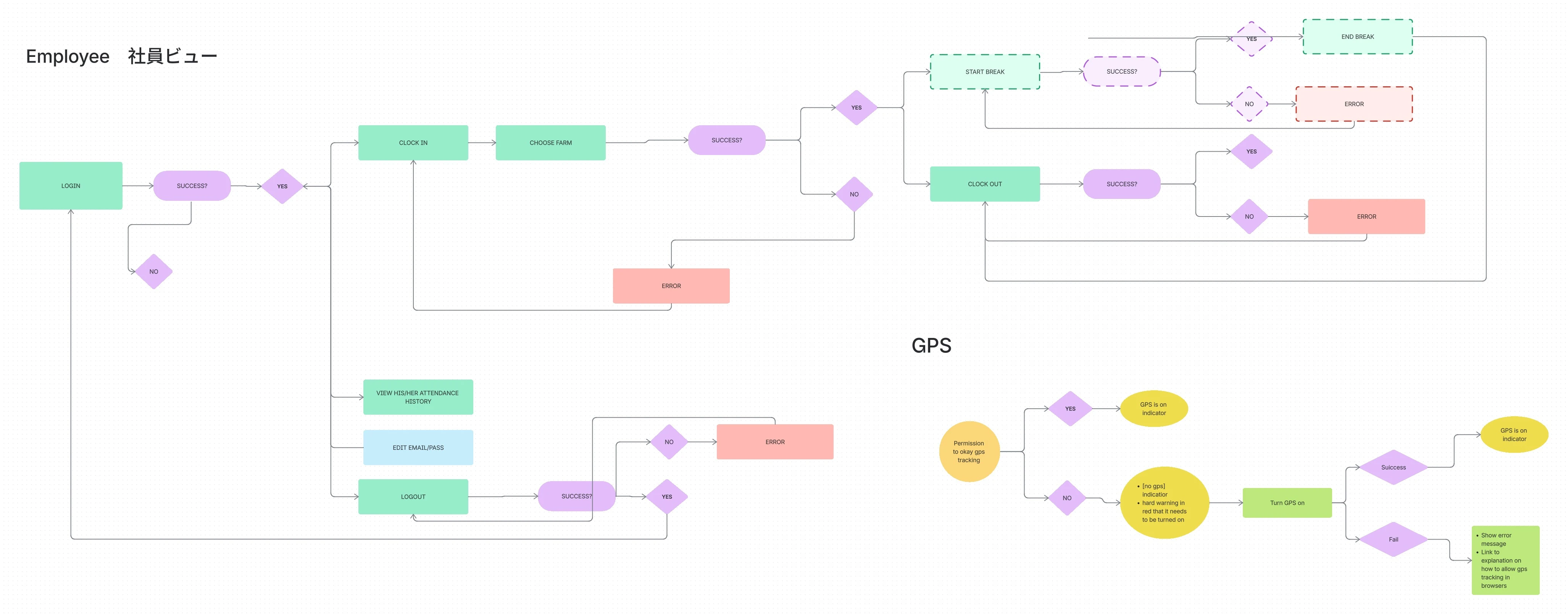
I started by mapping the MVP check-in and check-out flows for both employees and managers.
Then I extended them to handle real-world cases like multiple entries, offline use, and sync.
Finally, I expanded into manager and admin workflows for attendance tracking, requests, and management.
low fidelity wireframes
I created low-fidelity wireframes to quickly define the core flows and structure of the app.
Focused on clarity and simplicity, prioritizing large actions and minimal steps over visual detail.
Used these to validate flows early and iterate quickly before moving into UI design.


design system
I used an existing design system I had previously built as a foundation and adapted it to fit this project.
Expanded it to support larger touch targets, clearer hierarchy, and simplified components for ease of use.
Focused on consistency and speed, allowing for faster design iterations while maintaining a cohesive experience.
The final UI evolved significantly from the initial wireframes, reflecting deeper UX thinking and refinement based on real-world use cases and feedback.
high fidelity wireframes
The final designs translate validated flows into a clean, production-ready interface with clear hierarchy, large touch targets, and highly visible actions.
The result is a simple, low-friction experience that minimizes cognitive load and works reliably in real-world farm conditions.


