
project overview
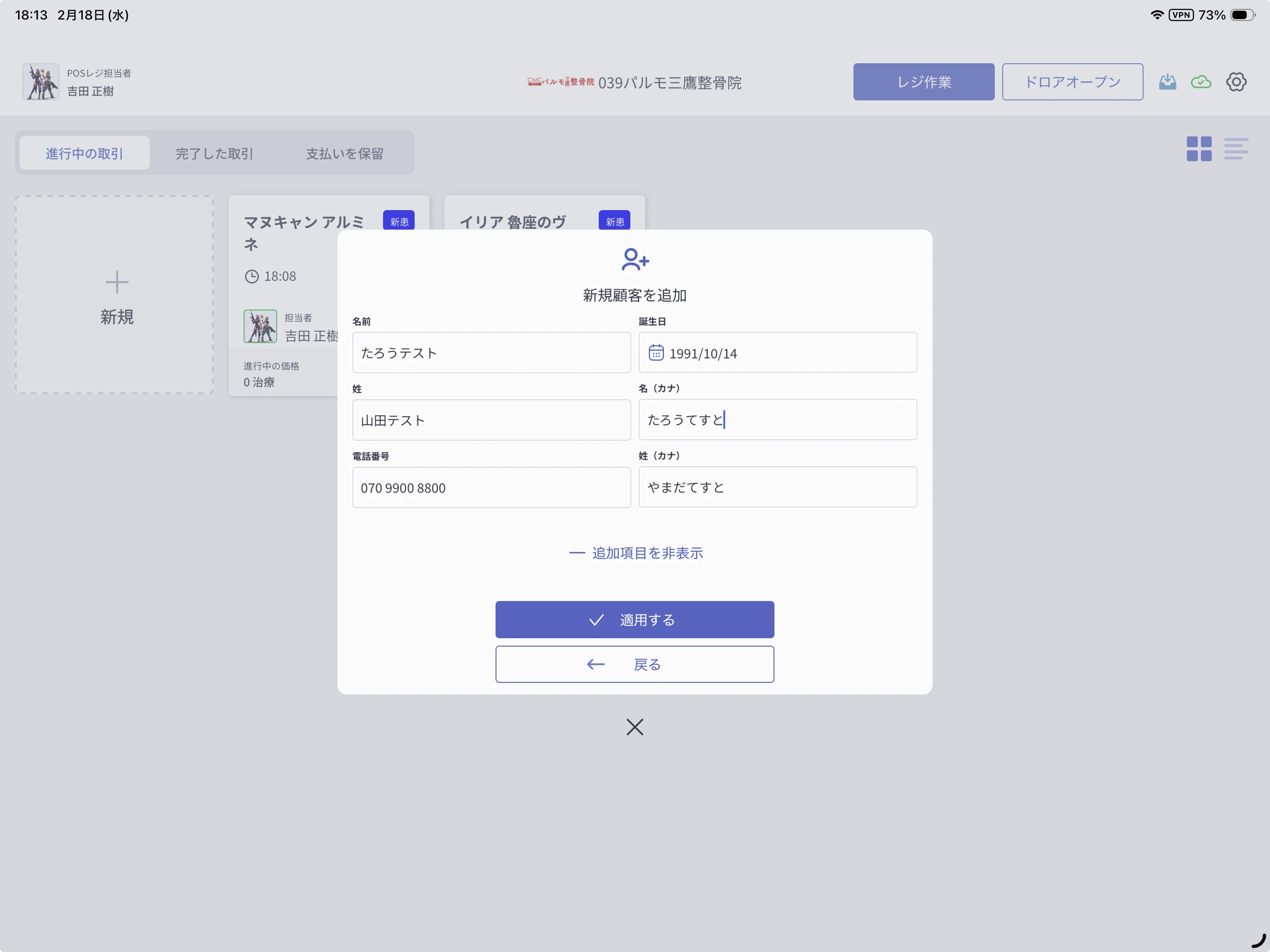
An integrated POS, admin, and BI system designed for Japanese clinics, supporting sales, treatment workflows, session management, customer tracking, ticket (回数券) usage, refunds, and analytics in one platform.
The project was driven by limitations in the clinic’s existing system, which lacked flexibility for clinic-specific workflows, required frequent workarounds, and came with high usage and hosting costs.
Designed around real clinic operations — treatments, sessions, and long-term customer relationships — the system simplifies daily workflows while improving overall usability.
my role
Responsible for UX flows, UI design, requirements, Japanese UI microcopy, feature logic, and translating business operations into usable product design.
tools used
Figma, Jira, Confluence, Slack, Fig jam, Miro, Excel, Zoom
the challenge
The system we were tasked to develop was not a simple POS. It needed to support the full scope of daily operations in Japanese treatment clinics, including register sessions, cash drawer checks, settlements, refunds, ticket (回数券) usage, transaction editing, insurance-related discounts, customer visit history, and staff workflows.
In addition, the system had to handle large-scale customer management, supporting 50,000+ customer records. This included creating and managing customers both from the POS and admin side, while ensuring that all relevant information — such as visit status, treatment history, and usage data — was easily accessible during real-time interactions.
The core challenge was to design a system capable of handling complex operational logic and large volumes of data, while still feeling simple, intuitive, and fast for front-desk staff during busy clinic hours.
the goal
To design a scalable POS and clinic management system that makes daily operations faster, reduces mistakes, and gives clinic owners better visibility into sales, customers, staff activity, and business performance.
the process
An integrated POS, admin, and BI system designed for Japanese clinics, supporting sales, treatment workflows, session management, customer tracking, ticket (回数券) usage, refunds, and analytics in one platform.
The project was driven by limitations in the clinic’s existing system, which lacked flexibility for clinic-specific workflows, required frequent workarounds, and came with high usage and hosting costs.
Designed around real clinic operations — treatments, sessions, and long-term customer relationships — the system simplifies daily workflows while improving overall usability.
hearing/research
I conducted hands-on research directly with clinics using existing systems.
This included:
- Visiting clinics in person
- Experiencing the full customer journey ourselves (from check-in to checkout)
- Observing real staff workflows at the front desk and during operations
- Conducting informal interviews with staff to understand daily pain points
I followed the entire process: Customer enters → registration → treatment → payment → checkout → session closing
This allowed us to identify not just surface-level issues, but operational friction in real environments.
In parallel, I conducted competitive research:
- Analyzed the existing tool the company used - Smaregi
- Reviewed multiple POS systems used in retail, beauty, and clinic environments
- Identified UX gaps, missing workflows, and mismatches between system design and real usage
current system analysis
Smaregi is a cloud-based POS system widely used across retail, food service, and service industries, offering features like sales tracking, customer management, inventory, and multi-store support.
strengths
feature-rich & scalable
Handles sales, inventory, customer data, and analytics in one system. Supports multi-store operations and large datasets.
offline support
Can operate without internet and sync later, ensuring reliability.
real-time data & analytics
Centralized cloud data enables reporting and performance tracking.
hardware flexibility
Runs on iPad/iPhone and supports peripherals (cash drawers, scanners, etc.).
weaknesses
not designed for clinic workflows
Built primarily for retail/food service. Lacks core concepts like treatment sessions, staff assignment per service, insurance logic, and treatment-based history.
fragmented experience
Advanced functionality depends on external apps, add-ons, and complex configuration → increases cognitive load.
cash handling is too generic
No structured session-based register flow. Weak support for opening/closing checks, mid-session adjustments, and staff accountability.
ux is functional, not intuitive
Heavy use of tables and settings. Not optimized for fast-paced environments or non-technical users.
poor product/catalog management at scale
Across 50+ branches, treatments cannot be flexibly managed. Different pricing requires duplicating the same service multiple times, leading to a cluttered, hard-to-maintain catalog.
limited customization
Cannot adapt easily to business-specific logic → clinics forced to adjust their operations to the system.
competitor snapshot
AirREGI
Strengths
Very simple UI
Easy onboarding
Free entry-level usage
Weaknesses
Limited advanced features
Weak analytics
Not scalable for complex operations
Square POS
Strengths
Clean, modern UX
Strong payment integration
International standard UI patterns
Weaknesses
Limited localization for Japanese workflows
Weak support for niche industries like clinics
Custom workflows require workarounds
STORES レジ
Strengths
Integrated ecosystem (payments, online store, reservations)
Simple setup
Weaknesses
Limited flexibility
Not designed for complex workflows
Basic reporting
